
Capsulectomy Topics
What Is Breast Capsule Formation?
As a protective mechanism, a fibrous capsule will naturally form around any foreign object introduced into the body. The capsule that forms around breast implants functions as a snug container for the devices, keeping them in place. However, some women experience complications such as capsular contracture after their breast augmentation, which require surgical intervention. A capsulectomy in Beverly Hills helps patients to alleviate discomfort and restore quality of life.
What is a capsulectomy?
Capsular contracture is a complication that can occur after breast augmentation with implants. It occurs when the scar tissue around the implants hardens and contracts, causing both discomfort and cosmetic distortion. In this case, a capsulectomy can be performed in tandem with breast implant removal to restore well-being and overall health. Capsulectomies can also be performed when cancer or infection occurs.
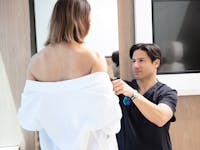
What are the different types of capsulectomies?
Total capsulectomy
With this option, the capsule material is removed separately after the implant has been taken out. The doctor will first dissect the superficial pocket surface, then carefully extract the rest of the capsule down to its deepest level.
Partial capsulectomy
This method is the least invasive approach to removing the capsule. Only a portion of the capsule is excised, leaving the remaining sections to be resorbed with the passage of time.
En bloc capsulectomy
With this approach, the entire capsule is removed at the same time as the implant. While this type of surgery is more complex and demanding, it is often the recommended choice for women who are dealing with the effects of BIA-ALCL (breast implant-associated anaplastic large cell lymphoma), a complication that occasionally occurs after breast augmentation and has been connected to textured implants.
Am I a Candidate for a Capsulectomy?
Not every patient with capsular contracture requires immediate surgery, but for those experiencing discomfort or distortion, a capsulectomy can provide significant relief. Candidates typically experience pain, firm or misshapen breasts, implant displacement, or suspected implant rupture or infection.
Plastic surgeons evaluate the severity of capsular contracture using the Baker Grading Scale. Surgery is generally recommended for patients with Grade III or Grade IV contracture.
The Baker Grading Scale
| Grade | Description | Appearance & Feel | Surgery Indicated? |
| Grade I | Normal Capsule | Breast is soft and looks natural. | No |
| Grade II | Mild contracture | Breast is slightly firm but looks normal. | Usually No (Monitor closely) |
| Grade III | Moderate contracture | Breast is firm and visibly distorted or asymmetric. | Yes (Capsulectomy recommended) |
| Grade IV | Severe contracture | Breast is hard, cold to touch, distorted, and painful. | Yes (Capsulectomy strongly recommended) |
What are the Benefits of a Capsulectomy?
- Improves comfort and ease
- Provides relief from implant complications
- Excises painful, hardened scar tissue
- Allows for replacement of damaged or compromised implants
- Corrects the aesthetic appearance of the breasts
- Restores peace of mind
- Enhances overall quality of life

Who Else Is a Good Candidate?
Beyond capsular contracture, you may be a candidate for a capsulectomy if you are experiencing:
- Silicone Leakage or Rupture: Requires total or en bloc removal of the capsule and silicone gel.
- BIA-ALCL or BII (Breast Implant Illness): Requires a complete en bloc capsulectomy to remove the capsule and implant intact.
- Persistent Infection: Recurrent late-onset fluid (seroma) or chronic infection around the implant.
During your private consultation in Beverly Hills, Dr. Cohen will conduct a thorough physical evaluation, review imaging if necessary, and determine whether a total, partial, or en bloc capsulectomy is right for your goals.
What is the cost for a Capsulectomy in Beverly Hills?
The cost of a capsulectomy varies depending on the complexity of the procedure, the type of capsulectomy performed, and whether additional treatments, such as breast implant removal, implant replacement, or a breast lift, are included. During your consultation, Dr. Robert Cohen will evaluate your condition, discuss your goals, and provide a personalized treatment plan with detailed pricing information.
What can I expect from the procedure?
Surgery is typically performed under IV sedation so that you are completely comfortable and at ease during the procedure. You will not feel any pain or remember anything. The process takes about 2-3 hours.
As a first step, the doctor will create an incision within the breast along the inframammary fold. He will then pursue a partial, total, or en bloc capsulectomy, according to your customized treatment plan. If required, Dr. Cohen can place new implants at this point. He may also place ADM (acellular dermal matrix), a unique mesh that mimics human skin and helps reduce the risk of capsular contracture.
The incisions are then closed, and drains are placed as needed.
Considering breast augmentation but still have questions? Dr. Cohen’s team welcomes you to schedule a one-on-one consultation, where all your concerns can be thoughtfully addressed in a comfortable, supportive setting.
Contact our team today
What Can I Expect After Capsulectomy Surgery?
Recovery
Recovery varies based on the type of capsulectomy performed (partial, total, or en bloc) and whether implants are replaced, removed, or combined with a breast lift. While full recuperation generally takes 4 to 6 weeks, most patients resume light routines much sooner.
Common Recovery Symptoms
Swelling, bruising, tenderness, mild tingling, and temporary numbness around the breast area are completely normal side effects as nerves and tissue heal. Dr. Cohen provides personalized pain management and clear aftercare instructions to keep you comfortable throughout every stage. To help accelerate your healing and reduce post-surgical swelling, gentle breast massage or specialized lymphatic massage may be recommended as part of your recovery plan.
Capsulectomy Recovery Timeline
Days 1–3
Peak Rest & Support: Soreness, swelling, and chest tightness are highest. Surgical drains (if placed) are usually managed during this window.Activity & Care Guidelines: Rest at home, take prescribed pain medications, and sleep on your back with your upper body elevated.
Week 1
Early Healing: Pain transitions from sharp to a dull ache. Drains are typically removed around day 5–7 if output is low enough.Activity & Care Guidelines: Gentle short walks around the house to prevent blood clots. No driving while on prescription pain medications.
Week 2
Return to Light Routine: Bruising and initial tightness begin to subside. Most sutures (if non-dissolvable) are checked or removed.Activity & Care Guidelines: Many patients return to non-strenuous desk jobs. Driving is usually permitted once off narcotics and full arm range of motion returns.
Weeks 3–4
Noticeable Improvement: Energy levels rebound and residual swelling continues to clear. Tissue begins to soften.Activity & Care Guidelines: Light low-impact activities (e.g., slow flat walking or stationary bike) may be approved. Still no heavy lifting (>10 lbs) or upper-body strength training.
Weeks 6–8
Full Activity Clearance: Incisions are closed and internal tissue has stabilized significantly.Activity & Care Guidelines: Most physical restrictions are lifted. You can usually resume running, high-impact workouts, and swimming once cleared by Dr. Cohen.
Months 3–6
Final Softening & Maturation: Residual microscopic swelling clears, scars mature, and final breast contours settle.Activity & Care Guidelines: Full return to all normal routines, standard underwire bras (if desired), and unmanaged activity.





Why Choose Dr. Robert Cohen for a Capsulectomy?
Complex capsulectomy and revision procedures require an exceptional level of surgical precision. Patients trust board-certified plastic surgeon Dr. Robert Cohen for his extensive experience in treating severe capsular contracture and delicate tissue reconstruction.
- Top Medical Honors: Earned the highest surgical honors at Tulane University School of Medicine and authored research published in Plastic and Reconstructive Surgery®.
- Elite Reconstructive Training: Completed his plastic surgery residency at the prestigious Dartmouth-Hitchcock Medical Center.
- Specialized Los Angeles Fellowship: Selected for an exclusive aesthetic surgery fellowship under internationally acclaimed surgeon Dr. W. Grant Stevens.
- Nationally Awarded Expertise: Consistently named a Castle Connolly Top Doctor for surgical excellence and patient care.
Dr. Cohen combines advanced surgical skill with an artistic approach, ensuring complete capsule removal while restoring a safe, natural, and comfortable aesthetic outcome.

Capsulectomy FAQs
What signs suggest capsular contracture is progressing?
Increasing tightness, firmness, distortion, or discomfort that interferes with daily activity can indicate advancing contracture and the need for evaluation.
What factors raise the risk of developing capsular contracture?
Prior contracture, infection, hematoma, smoking, and certain implant types or placements can elevate risk. Dr. Cohen will assess these during consultation.
How do I decide between implant removal, replacement, or fat grafting after a capsulectomy?
The choice depends on your anatomy, goals, implant condition, and preference for staying implant-free.
Can a capsulectomy affect future breast surgery options?
Because it changes the internal pocket and tissue quality, it can influence future lift, revision, or reconstruction planning.
Can breast pain unrelated to confirmed contracture improve after capsulectomy?
If the capsule contributes to the discomfort, removing it may help, though a full evaluation is needed to rule out other causes.
How long do results from a capsulectomy usually last?
Results are typically long-lasting when the underlying issue is corrected and risk factors are managed, though recurrence remains possible for some patients.
Can a capsulectomy be combined with a lift or other cosmetic procedures?
Yes, combined procedures are often feasible when addressing sagging, asymmetry, or volume needs, depending on safety and goals.
What should patients ask during a capsulectomy consultation?
Questions about surgeon experience, incision approach, expected results, recovery, and whether ADM or implant replacement is recommended are helpful.
When can patients safely return to work, travel, or exercise?
Light activity often resumes within one to two weeks, with strenuous exercise requiring more time. Timelines vary by procedure and healing progress.